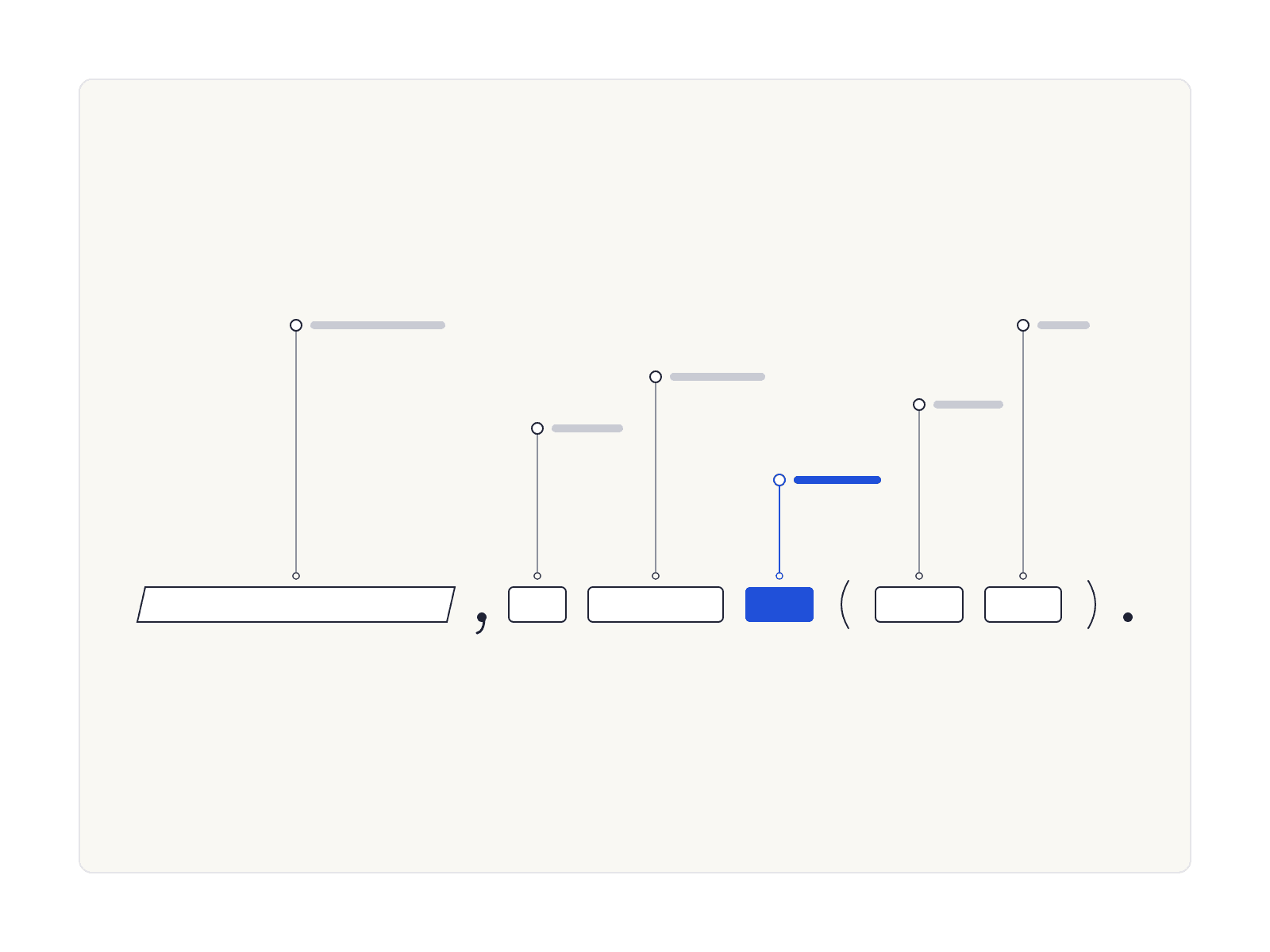

Bluebook signals: see, see also, cf., but see, e.g.
3 min readChecked against the Bluebook, 22nd ed. (2025)
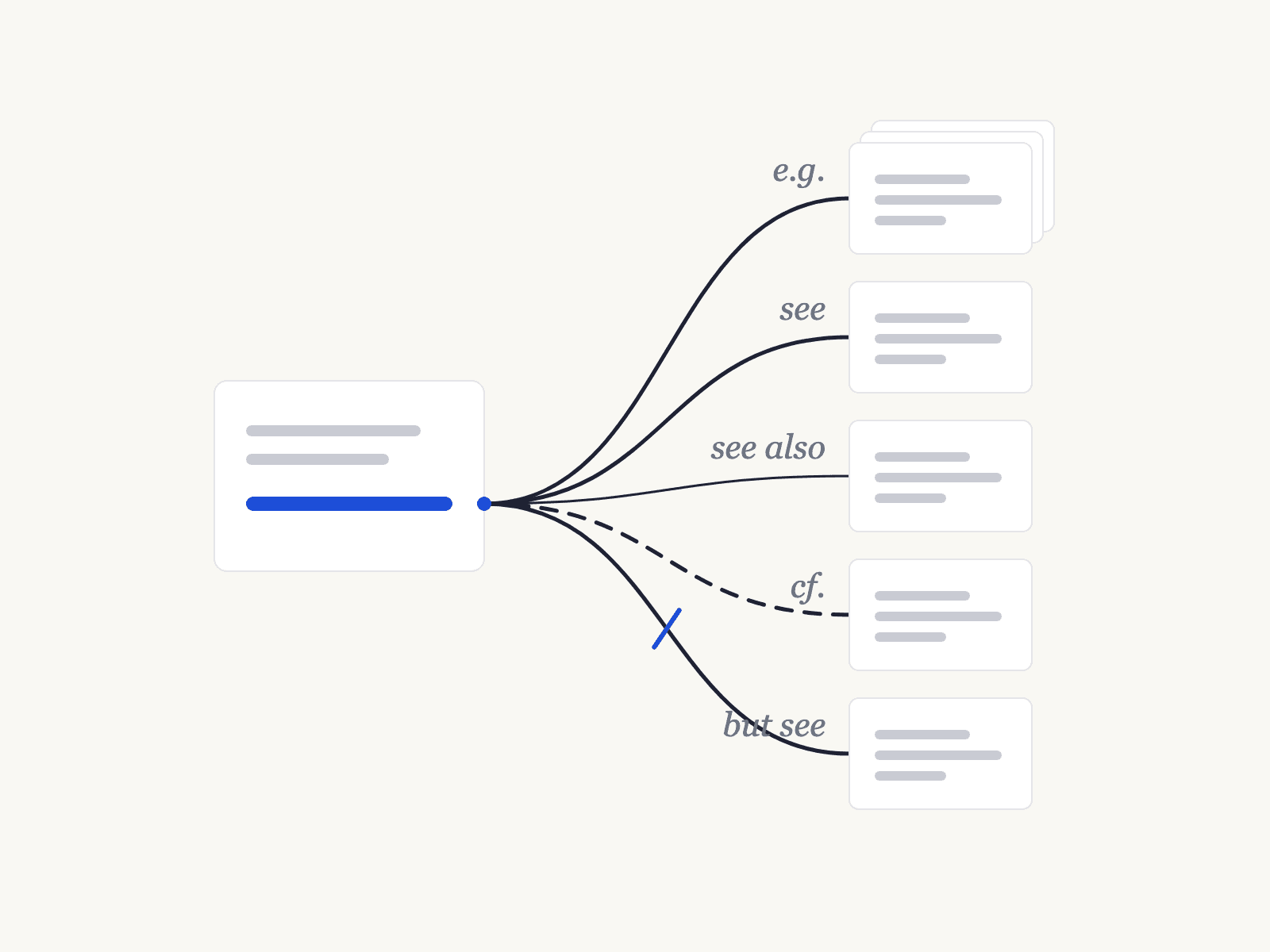
What each Bluebook signal tells the reader, which ones must carry a parenthetical, and how they are punctuated and ordered.
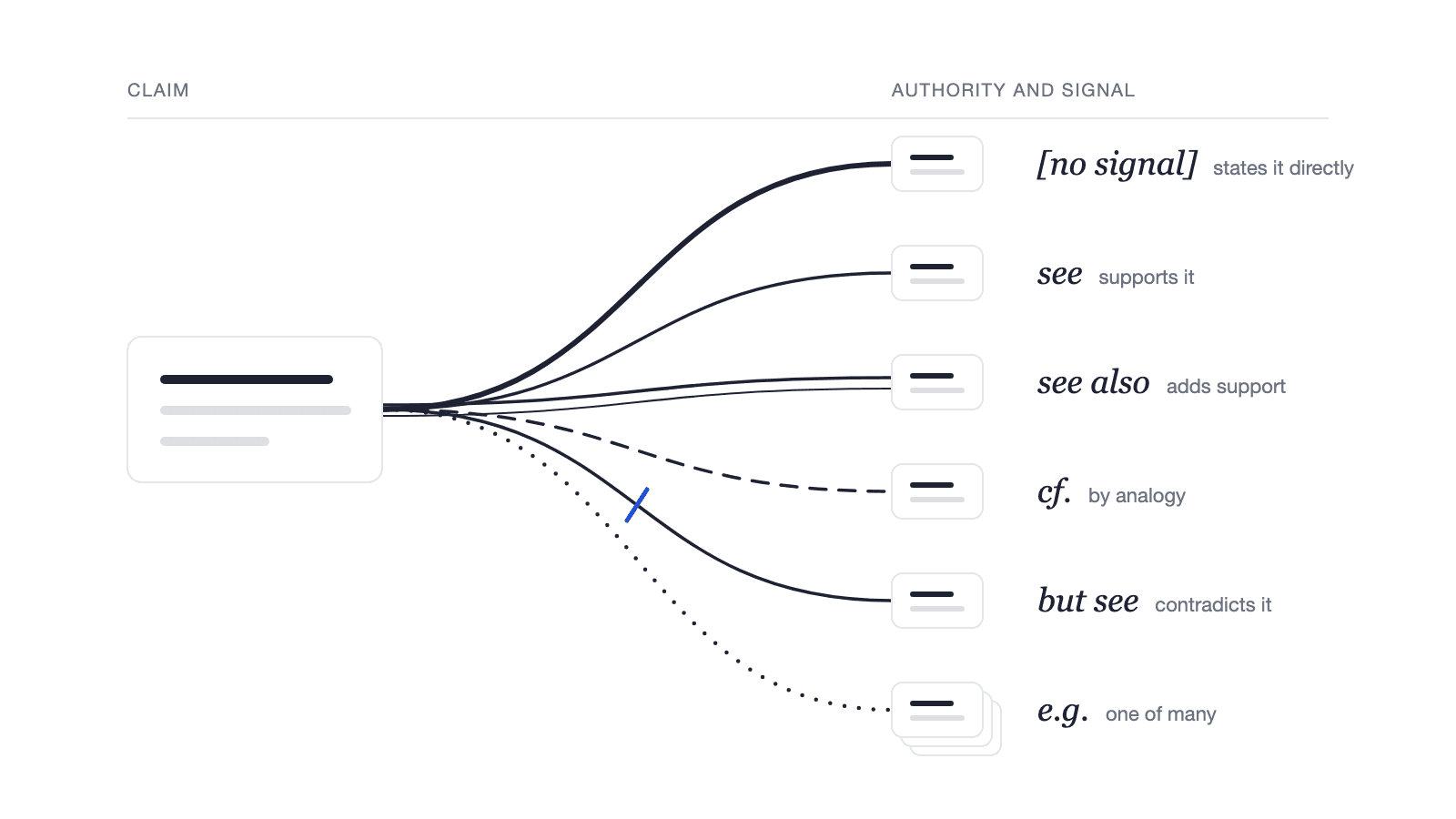
What each signal means
| Signal | The authority… | Parenthetical | Example |
|---|---|---|---|
| No signal | States the point, or is the source of the quotation. | Not required | Anderson, 477 U.S. at 248. |
| E.g., | States the point, and so do others you are not listing. Attaches to any signal. | Not required | E.g., Anderson, 477 U.S. at 256. |
| Accord | Also states the point, after another authority was quoted or named for it. | Not required | Accord Celotex, 477 U.S. at 322. |
| See | Supports the point without stating it. | Not required | See Celotex, 477 U.S. at 323. |
| See also | Adds support after the main authority has been cited. | Required | See also Anderson, 477 U.S. at 252 (requiring more than a scintilla). |
| Cf. | Decides a different question whose reasoning carries over. | Required | Cf. Iqbal, 556 U.S. at 678 (disregarding conclusory allegations). |
| Compare … with | Two similar authorities, read together, make the point. | Required, on each | Compare Twombly, 550 U.S. at 570 (requiring plausible facts), with Iqbal, 556 U.S. at 684 (applying it to every civil action). |
| Contrast … with | Two differing authorities, read together, make the point. New in the 22nd edition. | Required, on each | Contrast Conley, 355 U.S. at 45 (any set of facts), with Twombly, 550 U.S. at 563 (retiring that test). |
| Contra | States the opposite. | Not required | Contra Twombly, 550 U.S. at 563. |
| But see | Supports the opposite without stating it. | Not required | But see Iqbal, 556 U.S. at 678. |
| But cf. | Supports something analogous to the opposite. | Required | But cf. Matsushita, 475 U.S. at 587 (requiring a plausible inference). |
| See generally | Gives background, not authority for the point. The one signal that needs no pincite. | Required | See generally 10A Wright, Miller & Kane, supra, § 2727. |
The three mistakes
No comma after a signal. E.g. is the exception: a comma follows it, and one precedes it when it joins another signal.
- Wrong
- See, Anderson, 477 U.S. at 248.
- Right
- See Anderson, 477 U.S. at 248. See, e.g., Celotex, 477 U.S. at 323.
See also, cf. and but cf. carry a parenthetical saying why the authority is there. Write it as a present participle, with no period inside.
- Wrong
- Cf. Iqbal, 556 U.S. at 678.
- Right
- Cf. Iqbal, 556 U.S. at 678 (disregarding conclusory allegations).
Signals run in the order shown above, and a signal of another kind starts a new citation sentence: a but see after a see follows a period, capitalised. Authorities under one signal are separated by semicolons.
- Wrong
- See Anderson, 477 U.S. at 248; but see Iqbal, 556 U.S. at 678.
- Right
- See Anderson, 477 U.S. at 248. But see Iqbal, 556 U.S. at 678.
In a court document the signal is italicised, capitalised when it opens a citation sentence, and lowercase inside a clause. Only the first negative signal keeps its but: but see and but cf. together are but see …; cf. ….
Questions people ask
- What is the difference between see and see also?
- See introduces an authority that supports the point without stating it. See also adds further support after the main authority has already been cited, and under the 22nd edition it carries a parenthetical saying what the added authority holds.
- Do you put a comma after see?
- No. The citation follows the signal directly. E.g. is the exception: E.g., Anderson, or See, e.g., Anderson.
- When do you use cf.?
- When the authority decides a different question but its reasoning supports yours by analogy. Say what the analogy is in a parenthetical; a bare cf. leaves the reader to guess.