

A second set of eyes on every legal document.
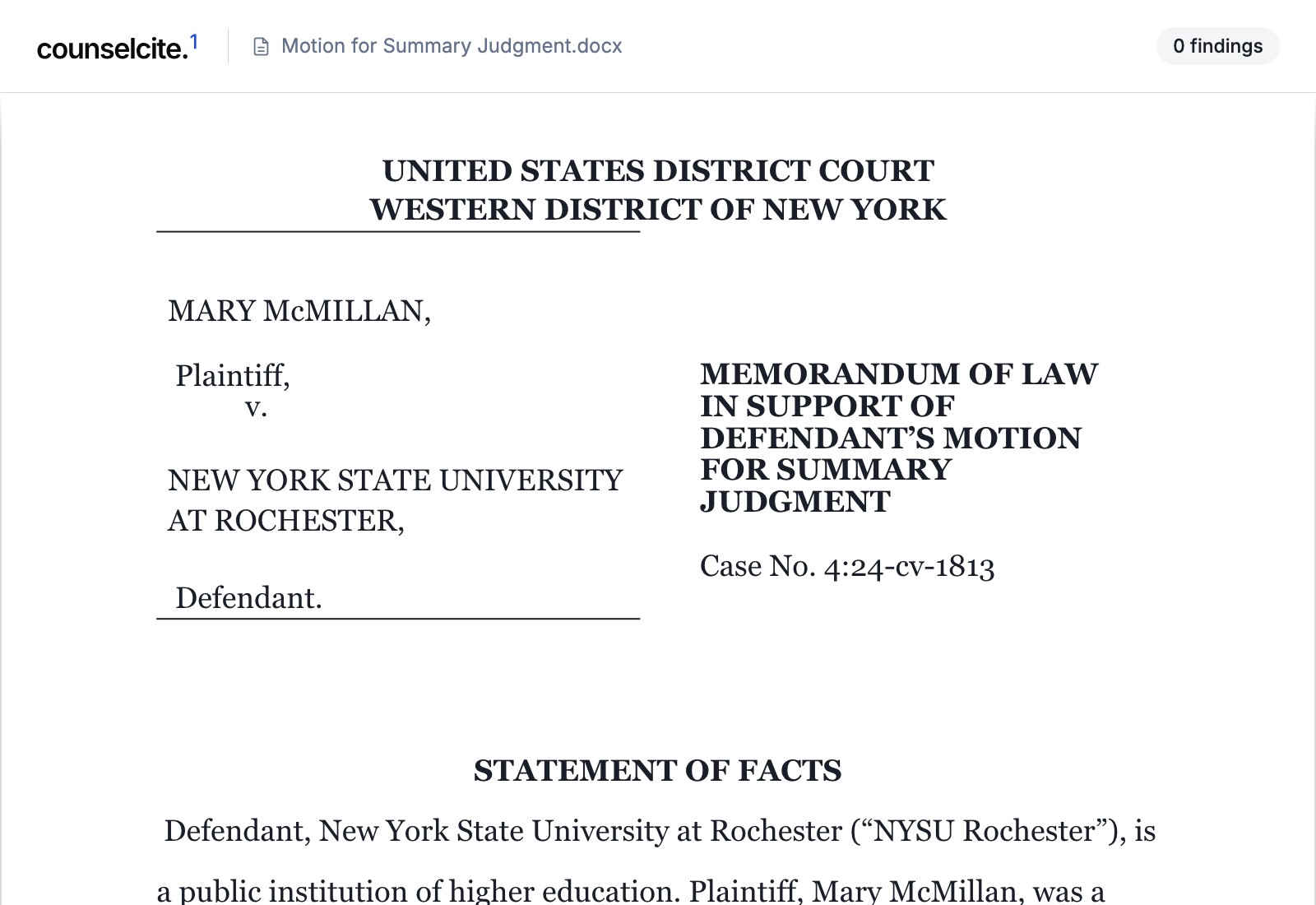
Upload a motion. Counselcite checks every citation against the Bluebook and every cited case against the court record, then hands back the same file with the corrections you accepted.
Free for ten documents a week.
Watch a document get checked.
What it finds.
Wrong form
The citation is right but its form isn’t: page ranges, court parentheticals, signals, short forms, id., and Table T6 abbreviations. We check them against Rules 1 through 21 and Tables T1 through T16 of the 21st and 22nd editions, and every check is listed in the rule library.
- Written
- 477 U.S. 242, 247-248, (1986)
- Corrected
- 477 U.S. 242, 247-48 (1986)
- Rule
- Rule 3.2(a), Rule 10.5
Cases the record contradicts1
477 U.S. 242 is Anderson v. Liberty Lobby. If a document calls it something else, or gives the wrong year or court, we flag it.
- Written
- Anderson v. Liberty Lobby, Inc., 477 U.S. 242 (1988)
- Corrected
- Anderson v. Liberty Lobby, Inc., 477 U.S. 242 (1986)
- Record
- Decided June 25, 1986
What's missing
Things a citation should carry and doesn't: a docket number on a database cite, a short form where the authority was already cited in full, or an id. that could point to two authorities. We judge short forms against the first full citation of the same authority earlier in the document, and id. against the citation just before it.
- Written
- 2015 U.S. Dist. LEXIS 27118
- Corrected
- No. 10-cv-05139, 2015 U.S. Dist. LEXIS 27118
- Rule
- Rule 10.8.1(a)
From upload to a corrected document in three steps.
Step 1 of 3
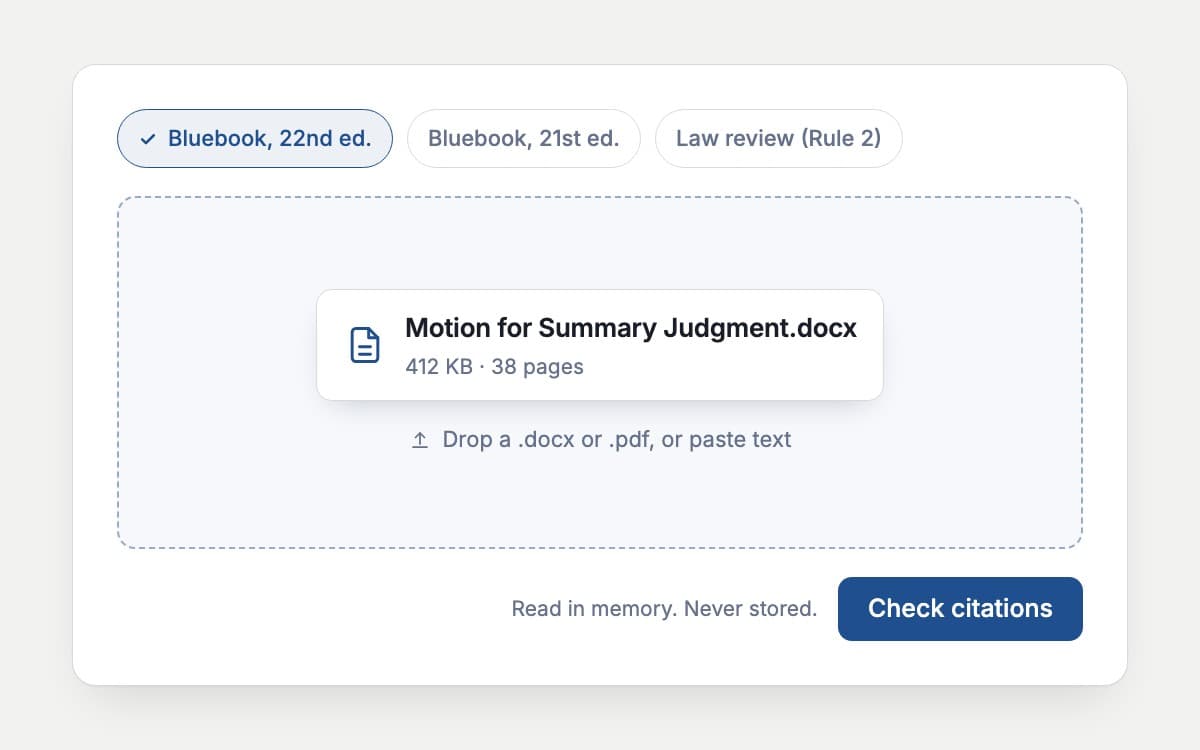
Upload the document
Drop in a Word file or a PDF, or paste the text, and pick the edition your court or journal uses. A 40-page document takes a few seconds.
Step 2 of 3
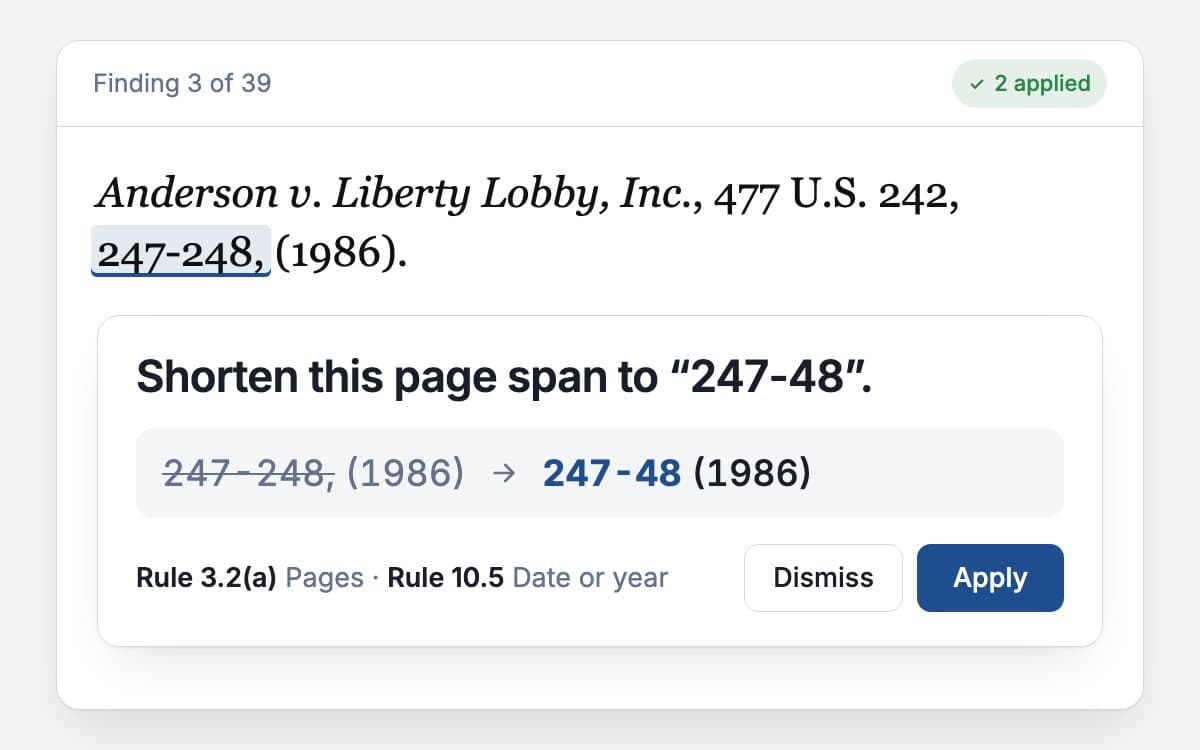
Review each finding
Each finding sits beside the text it's about. Accept it or dismiss it; your document doesn't change until you accept one.
Step 3 of 3
Download the corrected document
You get the same file back with only the corrections you accepted. Footnotes, styles, fields and images stay as they were.
As written
A fact is material if it might affect the outcome of the suit under the governing law. Anderson v. Liberty Lobby, Inc., 477 U.S. 242, 247-248, (1986). The moving party bears the initial burden of showing the absence of a genuine dispute. Celotex Corp. v. Catrett, 477 U.S. 317, 322-323 (1986). Id., at 323. Overtime is owed under 29 USCA § 207(a)(1).
As it comes back
A fact is material if it might affect the outcome of the suit under the governing law. Anderson v. Liberty Lobby, Inc., 477 U.S. 242, 247-48 (1986). The moving party bears the initial burden of showing the absence of a genuine dispute. Celotex Corp. v. Catrett, 477 U.S. 317, 322-23 (1986). Id. at 323. Overtime is owed under 29 U.S.C.A. § 207(a)(1).
Four corrections were accepted here: two page spans, an id., and a code abbreviation. Everything else is as it was written.
We don't keep your document unless you ask us to.
- Read in memory, then discarded
- Unless you save it, we never write any part of the document to disk; it exists only for the length of the request.
- No third party sees it
- The checking runs on our own server. We don't send the text to a language model, a search API or any third party.
- Counts are kept, never the text
- Our usage log holds counts, never text, and a test fails the build if anyone adds a column for text.
- Saved only when you choose
- Signed in, you can save a document for seven days, thirty days or until you delete it, encrypted under a key that exists only for your account.
Who it's for.
Students and law reviews
Cite-check a note or an article under law-review conventions (Rule 2), and read the rule behind every finding.
See the law-review checks
Law firms
Check a filing before it goes out, accept the corrections you want, and download the same file with its formatting intact.
Check a document
Courts and agencies
For chambers, public defenders and agency counsel, on incoming filings as well as your own.
How documents are handledQuestions before you upload.
Does it use AI?
No. Counselcite applies the Bluebook's rules as written, through a parser and a fixed set of checks, and looks cases up in an index. Nothing is generated, so the same document always gets the same findings and every finding traces back to a rule.
Which editions and formats?
The 21st and 22nd editions, including the Bluepages for court documents and Tables T1 through T16, plus law-review style under Rule 2. Upload a .docx or a .pdf, or paste text, up to 10 MB. We check italics and underlining in a Word file; a PDF carries no typeface information, so we report those checks as skipped rather than as errors. Every check is listed in the rule library.
What does “not confirmed” mean for a case?
We look each case up in the public court record by reporter, volume and page, and compare its name, court and year with the opinion on file. If nothing is on record at that cite, we report it as not confirmed. That means we couldn't verify it, not that it's wrong: our index is a snapshot, and recent decisions are expected to be absent, so a miss is a prompt to look rather than a verdict.
What happens to my document?
By default nothing stays with us. We check the document in memory and it's gone when the response is sent. If you sign in you can save it for seven days, thirty days or until you delete it. The full details are in the privacy policy.
Does it change my document?
Only where you accept a correction. Everything else, including footnotes, styles, fields and images, comes back exactly as it went in. Pasted text and PDFs have no original file to edit, so we typeset those into a new document instead.
Check the document you’re working on now.
Free for ten documents a week. We don’t keep your document unless you save it.