
What courts did to lawyers who cited cases that do not exist
5 min read
Sixteen sanctions orders from 2023 to 2026: the court, what was cited, what it ordered and the rule it used. And how to check that a case exists before you file.
The orders
Since Mata v. Avianca, Inc., 678 F. Supp. 3d 443 (S.D.N.Y. 2023), courts have sanctioned lawyers for filing briefs that cite cases which do not exist, most of them written with a generative tool nobody checked. Damien Charlotin's database listed 2,044 such decisions worldwide on 19 September 2026, 1,397 of them American. These are the orders that set the pattern.
| Case | Court and date | What was cited | What the court ordered | Rule used |
|---|---|---|---|---|
| Mata v. Avianca, Inc. | S.D.N.Y., June 22, 2023 | Six cases that do not exist | $5,000 jointly on two lawyers and the firm; letters to the client and to each judge named as an author | Rule 11(b)(2), 11(c); inherent power |
| Park v. Kim | 2d Cir., Jan. 30, 2024 | One state case that does not exist | Published opinion; referral to the Grievance Panel; the decision sent to the client | Local Rule 46.2 |
| Gauthier v. Goodyear Tire & Rubber Co. | E.D. Tex., Nov. 25, 2024 | Two cases that do not exist; fabricated quotations in six real ones | $2,000; a one-hour AI course; the order sent to the client | Rule 11(b)(2) |
| Wadsworth v. Walmart Inc. | D. Wyo., Feb. 24, 2025 | Eight of nine cases do not exist | $3,000 and pro hac vice revoked for the drafter; $1,000 each for two signers | Rule 11 |
| Lacey v. State Farm Gen. Ins. Co. | C.D. Cal., May 6, 2025 | Nine of 27 cites wrong, at least two to cases that do not exist | Briefs struck; $31,100 on two firms | Rule 11; inherent power |
| Garner v. Kadince | Utah Ct. App., May 22, 2025 | One case that does not exist | Respondents' fees; $1,000 to legal aid; refund of the client's fees | Utah R. App. P. 40 |
| Mid Cent. Operating Eng'rs v. HoosierVac LLC | S.D. Ind., May 28, 2025 | Cases that do not exist, in three separate briefs | $6,000 ($15,000 recommended) | Rule 11 |
| Coomer v. Lindell | D. Colo., July 7, 2025 | Nearly thirty defective cites, some to cases that do not exist | $3,000 on lead counsel and the firm; $3,000 on co-counsel | Rule 11(c)(1) |
| Johnson v. Dunn | N.D. Ala., July 23, 2025 | Five fabricated cites across two discovery motions | Public reprimand; disqualified from the case; referred to every bar they answer to; notice to clients and other courts | Inherent power |
| Noland v. Land of the Free, L.P. | Cal. Ct. App., Sept. 12, 2025 | 21 of 23 quotations fabricated; a few cases do not exist | $10,000 to the clerk; opinion served on the client; State Bar notified | Cal. R. Ct. 8.276; CCP §§ 128.7, 907 |
| Couvrette v. Wisnovsky | D. Or., Dec. 12, 2025 | Fifteen cases that do not exist; eight fabricated quotations | Briefs struck; claims dismissed with prejudice; $15,500 to the clerk; defendants' fees, fixed at $94,704.38 in March 2026 | Rule 11(c)(4); local rules |
| Fletcher v. Experian Info. Sols., Inc. | 5th Cir., Feb. 18, 2026 | Sixteen fabricated quotations; five misstatements | $2,500 to the clerk | FRAP 46(c); inherent power |
| In re Nwaubani | 4th Cir., Mar. 11, 2026 | Three cases that do not exist | Public admonishment | Local Rule 46(g)(1)(c); D.C. RPC 8.4(d) |
| Whiting v. City of Athens | 6th Cir., Mar. 13, 2026 | More than two dozen fake cites and record misstatements | Fees and double costs; $15,000 punitive on each lawyer; referral to the chief judge | FRAP 38; inherent authority |
| Prososki v. Regan | Neb., Mar. 20, 2026 | 57 of 63 citations defective, by opposing counsel's count | Brief struck; appeal dismissed; referred to the Counsel for Discipline; suspended in April pending a hearing | Inherent authority |
| United States v. Farris | 6th Cir., Apr. 3, 2026 | Real cases with invented quotations and holdings | Removed from the case; CJA fees denied; referred to the chief judge; the opinion sent to the Kentucky bar | 18 U.S.C. § 3006A; 6th Cir. R. 46 |
What the courts used, and what they ordered
- Rule 11(b)(2) in the district courts: a signature certifies the legal contentions are warranted, and a case that does not exist warrants nothing. Fines ran from $2,000 to $31,100.
- Inherent power and local rules of professional conduct where Rule 11 did not fit, and FRAP 38 and 46 in the courts of appeals, which added punitive amounts and referrals to the chief judge.
- Beyond money: the order sent to the client, letters to the judges named as authors of invented opinions, disqualification from the case, referral to the bar, and in Nebraska suspension pending a hearing.
- The Fifth Circuit considered an AI-specific rule and declined to adopt one; the existing rules already reached the conduct.
How to check that a case exists
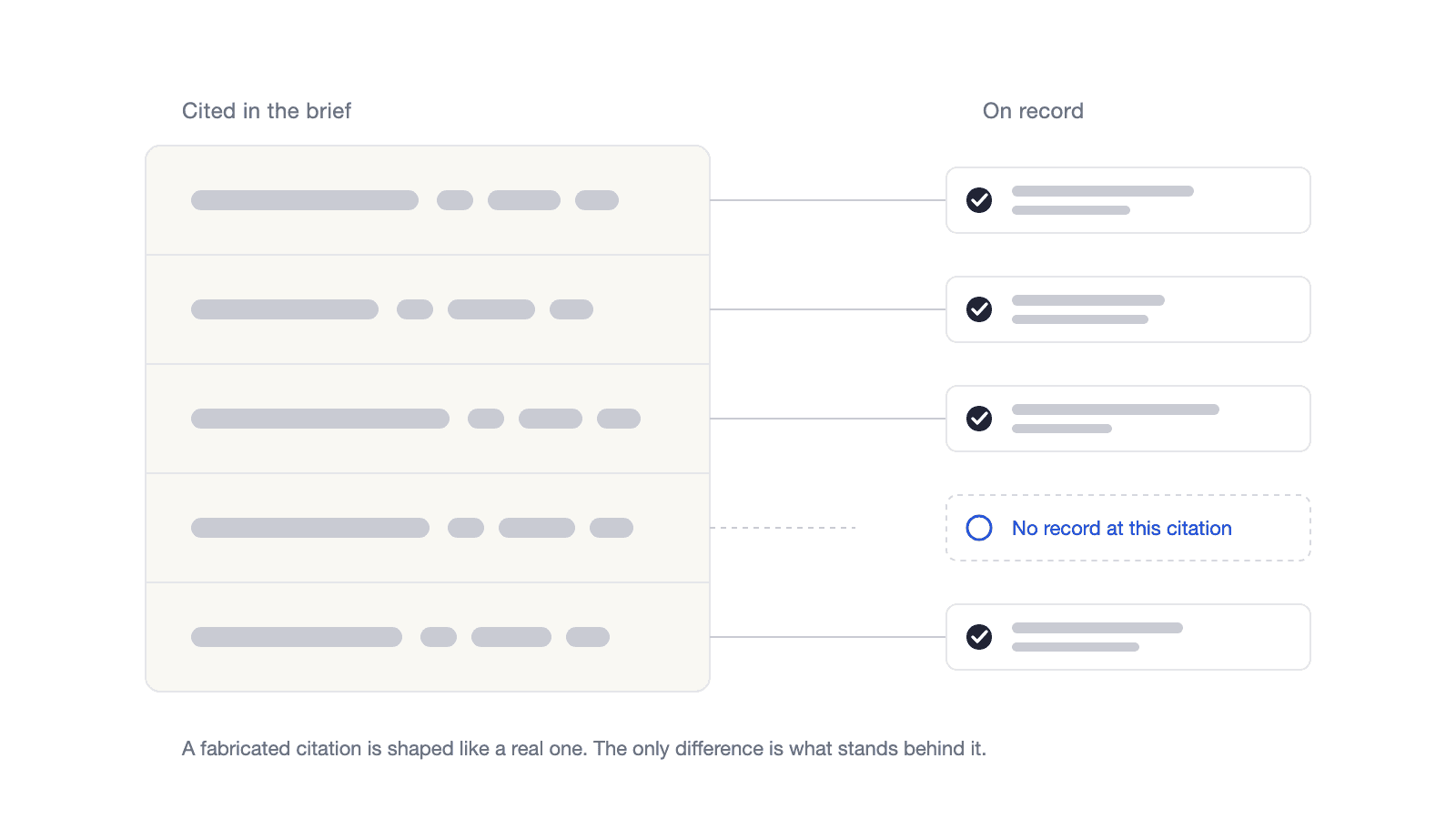
- Open the case at its reporter, volume and first page, on Westlaw, Lexis, or free at CourtListener. Not a search for the name: the page.
- Confirm the case name, the court and the year against the parenthetical. A real case at the wrong year or court is the second most common error.
- Find the pincite and read the passage you are citing it for. Fabricated quotations inside real cases were sanctioned in Gauthier, Fletcher and Farris.
- For a Westlaw or Lexis citation, confirm the docket number and date as well; the identifier alone proves nothing.
- Wrong
- Varghese v. China Southern Airlines Co., 925 F.3d 1339 (11th Cir. 2019).
- Right
- No case is reported at 925 F.3d 1339 under that name. Do not cite it.
Questions people ask
- Can you be sanctioned for citing a case that does not exist?
- Yes. Courts have used Rule 11, their inherent power, FRAP 38 and 46, and state analogues, imposing fines, fee awards, disqualification, bar referrals and, in one state, suspension. The orders above are the record.
- How do I verify a citation is real?
- Open the opinion at the reporter, volume and page cited and confirm the name, court, year and the passage you rely on. A name search is not enough; a fabricated citation often borrows a real name.
- Does Rule 11 apply to citations generated by AI?
- Rule 11 applies to the signer, however the brief was written: the signature certifies the legal contentions are warranted. The Fifth Circuit considered an AI-specific rule and declined to adopt one.